With flagship models such as GPT, Claude, and Grok opening their **APIs**, developers now have more AI integration options than ever before. However, differences in token pricing, model performance, and API usage costs can be significant, making it increasingly important to choose an API with the right balance between capability and cost.
With flagship models such as GPT, Claude, and Grok opening their APIs, developers now have more AI integration options than ever before. However, differences in token pricing, model performance, and API usage costs can be significant, making it increasingly important to choose an API with the right balance between capability and cost.
Among the growing number of AI API options, Grok API is becoming a new choice for developers. As Grok API usage continues to grow, with daily API requests exceeding 1 million calls, more users are paying attention to its pricing, model capabilities, and real-world operating costs.
This guide covers the latest Grok API Pricing, including token costs for different models, pricing methods, and comparisons with OpenAI API and Claude API. It also explains practical ways to reduce API expenses. If you only need Grok for everyday AI usage rather than development, you can also access Grok Subscription at a lower cost through GamsGo.
What is Grok API?
Grok API is an API service provided by xAI for developers. Through the API, developers can access Grok models for tasks such as text generation, reasoning, code processing, image understanding, tool calling, and structured outputs.
Compared with other AI APIs, Grok API combines real-time information retrieval with Grok’s reasoning capabilities, making it suitable for applications that require up-to-date data, dynamic content analysis, and real-time responses. This helps developers build AI applications with stronger contextual understanding and flexibility.
Another advantage of Grok API is its compatibility. The xAI API supports OpenAI and Anthropic SDKs, allowing developers to integrate Grok by creating an xAI API Key and updating the API endpoint and model name. This reduces migration costs for existing applications, AI agents, and automation workflows.
Grok API Pricing 2026: How Much Does It Cost?
Grok API does not have a fixed monthly subscription fee. The actual cost depends on the API type, selected model, and resource usage. xAI currently offers three main API categories: Text,Imagine, and Voice, covering text generation, image/video creation, and voice-related capabilities. Developers can choose the suitable API based on their project needs and pay according to actual usage.
This guide covers Grok API token pricing, billing methods, and model costs to help you choose the most suitable API option for your application.
Grok Text API Pricing
Text API is the core pricing category of Grok API. It uses a token-based pricing model, where developers are charged based on the number of input and output tokens consumed. The table below shows the cost of xAI Text API per 1 million tokens (1M tokens).
| Model | Short Context (≤200K Tokens) | Long Context (≥200K Tokens) |
|---|---|---|
| Input | Cached Input | Output |
| Grok 4.6 | $2.00 | $0.50 |
| Grok Build 0.1 | $1.00 | $0.20 |
| Grok 4.5 | $2.00 | $0.30 |
| Grok 4.3 | $1.25 | $0.20 |
| Grok 4.20 Series | $1.25 | $0.20 |
From a pricing perspective, Grok Build 0.1 offers the lowest token cost among the listed models.Grok 4.3 and the Grok 4.20 Series fall into the mid-range pricing tier, while Grok 4.5and Grok 4.6 have higher output token costs due to their more advanced model capabilities.
For models with Long Context Pricing, requests with a prompt context of 200K tokens or more are charged entirely at the Long Context rate. The higher pricing only applies to the full request, not just the tokens exceeding the 200K threshold. Therefore, long-context workloads may result in significantly higher costs compared with standard API usage.
Grok Imagine API Pricing
Grok Imagine API uses a usage-based pricing model, mainly charging based on the number of generated images or video duration. Pricing may vary depending on the selected model and generation type. The table below shows the detailed pricing for different Grok Imagine API features.
| Model | Primary Use Case | Pricing |
|---|---|---|
| grok-imagine-image-2.0 | Image generation and editing | $0.04–$0.08 / image |
| grok-imagine-image | Standard image generation | $0.02 / image |
| grok-imagine-image-quality | High-quality image generation | $0.05–$0.07 / image |
| grok-imagine-video-1.5 | Video generation | $0.08 / sec (480p) $0.14 / sec (720p) $0.25 / sec (1080p) |
| grok-imagine-video | Standard video generation | $0.05 / sec (480p) $0.07 / sec (720p) |
Overall, Grok Imagine API****pricing mainly depends on the type of content generated and the selected quality level. Choosing the right model and output specifications can help you better manage usage costs while meeting your generation needs.
Grok Voice API Pricing
Grok Voice API supports Speech-to-Speech, Speech-to-Text, and Text-to-Speech capabilities. Similar to Grok Imagine API, its pricing is based on usage, mainly depending on the audio duration processed or the number of text characters converted. The detailed pricing is shown below:
| Model / Mode | Primary Use Case | Pricing |
|---|---|---|
| grok-voice-think-fast-2.0 | Speech-to-Speech | $0.08 / min audio $0.004 / text input |
| Speech-to-Text | Speech recognition and transcription | $0.10 / hr (REST) $0.20 / hr (Streaming) |
| Text-to-Speech | Text-to-speech generation | $15 / 1M characters |
For Grok Voice API, Speech-to-Speech pricing mainly depends on the duration of voice interactions. Speech-to-Text (STT) is charged based on processed audio hours, with the Streaming mode costing more than the REST mode. Text-to-Speech (TTS) pricing is calculated based on the number of input characters.
How Do I Get a Grok API Key?
Currently, there are two main ways to access Grok API. The first option is to create your own Team through the official xAI Console, add credits, and generate an xAI API Key. The second option is to purchase access through GamsGo for a simpler setup process. The details are as follows:
Create a Team Through xAI Console
To get a Grok API Key through the official xAI platform, you need to create an xAI Team, choose a Starting Point such as Explore, Prototype, or Build, and add prepaid credits before generating your API Key.
The minimum starting credits are $5 for Prototype and $50 for Build, while users can also customize their own credit amount based on their API usage needs.
| Starting Point | Cost | Best For | Key Benefits |
|---|---|---|---|
| Explore | Free | Trying Grok API for the first time | Try Grok in Playground, browse models, and access documentation |
| Prototype | From $5 | Demos, prototypes, and small-scale testing | Access all models, build prototypes, and use around 4M input tokens |
| Build | From $50 | Production development and advanced testing | Better suited for product development, more tests and evals, and around 40M input tokens |
xAI provides a free Explore option for users who want to test and learn about Grok API. If you are only exploring Grok API features, you can start with Explore without adding credits.
When you are ready to make actual API calls, you can choose Prototype for small-scale testing or select Build for production development and advanced usage. You can also customize your credit amount based on your project needs. API usage costs will be automatically deducted from your account balance.
The official Grok API setup process includes four main steps: create an xAI Team, add Prepaid Credits, generate an xAI API Key, and use the API Key to call Grok models. After setup, developers can integrate Grok into applications, websites, AI agents, or other development workflows.
Get Grok API Access Through GamsGo
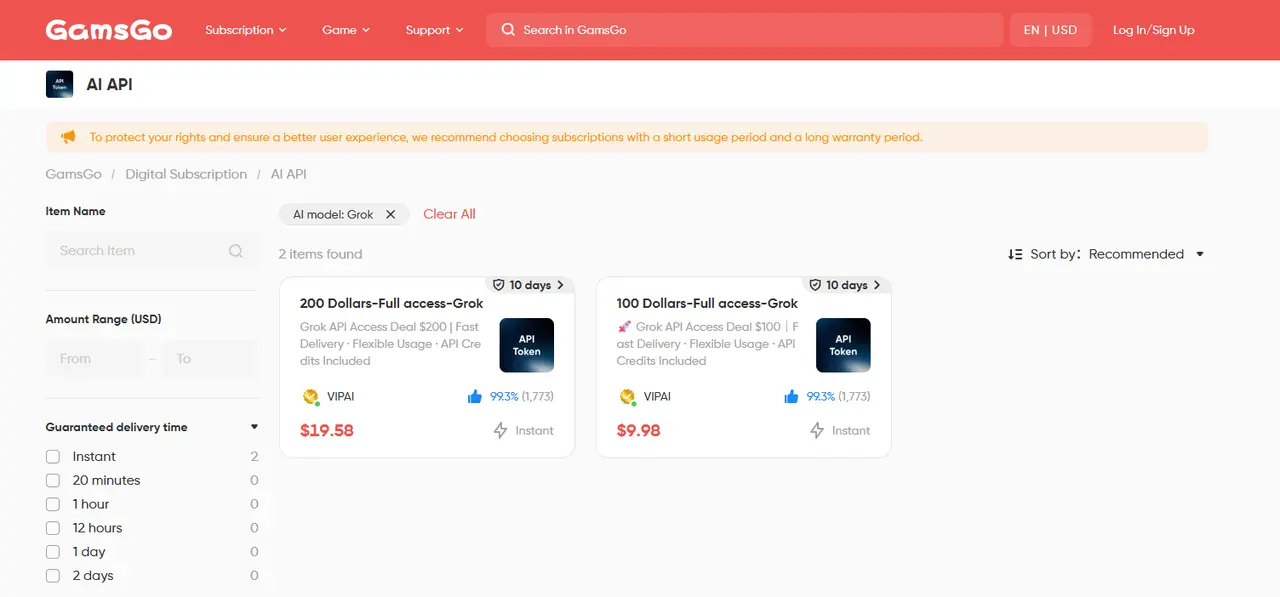
If you find the cost of an official Grok API Key too high, another option is to get Grok API Access through GamsGo. GamsGo allows you to access different AI API services at a significantly lower cost, with savings of over 90% in some cases. The table below shows the potential savings when using Grok API through GamsGo:
| GamsGo Grok API Access | Price | Included API Usage | Approx. Savings |
|---|---|---|---|
| Grok API Access $100 | $9.98 | $100 API Usage Credit | Over 90% |
| Grok API Access $200 | $19.58 | $200 API Usage Credit | Over 90% |
If you want to reduce API access costs and start using Grok API quickly, the GamsGo Grok API Key + Base URL solution can be a more convenient option. GamsGo is a subscription platform with more than seven years of operation, serving over one million users worldwide and providing a streamlined purchasing process with customer support.
The platform works with verified sellers to offer various software and digital services, including Grok API access, allowing you to choose a suitable option based on your usage needs and development requirements.
How Grok API Token Pricing Works?
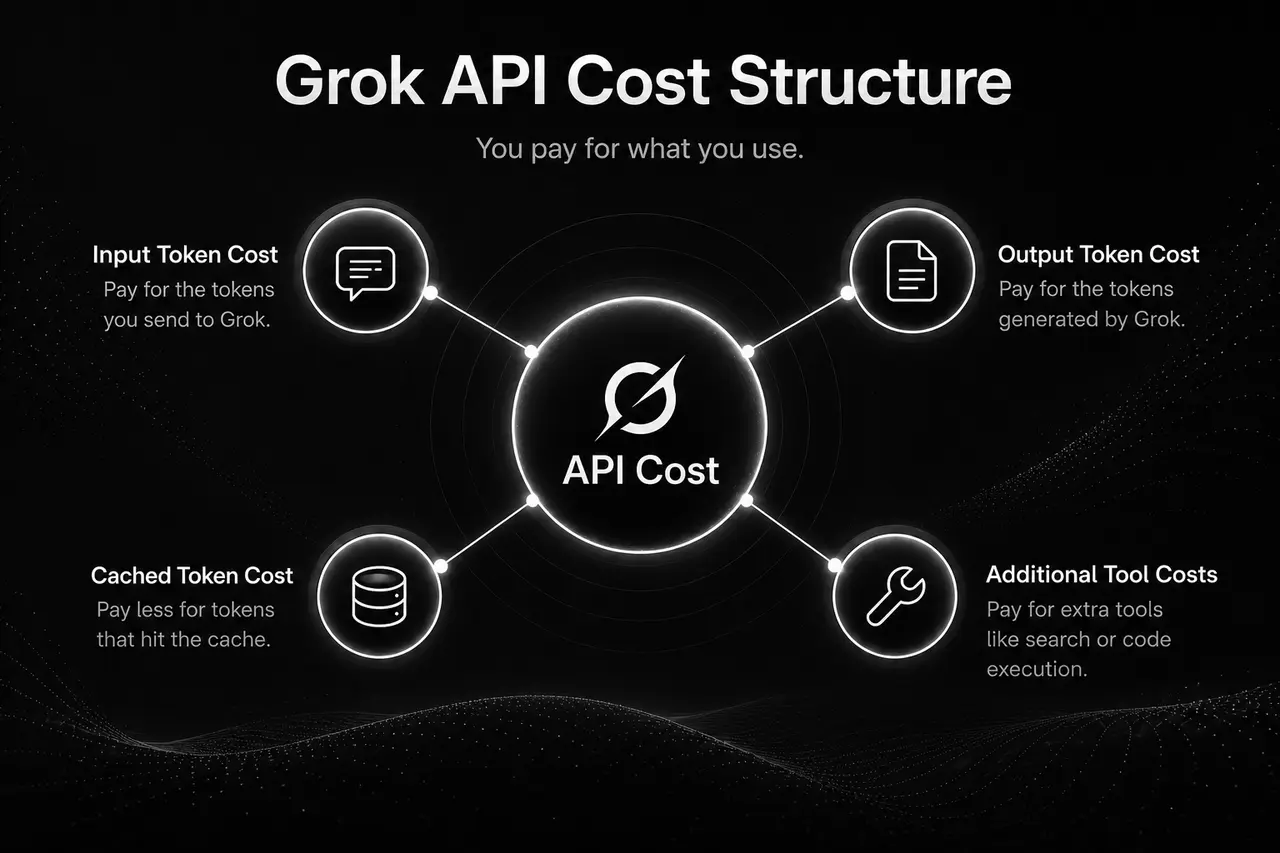
Grok API uses a pay-as-you-go pricing model, meaning users do not need to purchase fixed subscription plans and only pay for the resources consumed during API requests. For most text-based model calls, costs are mainly determined by token usage. Additional charges may apply when using server-side tools such as search or code execution. The main components of Grok API pricing include:
- **Input Tokens:**Input tokens refer to the content sent to the model, including user prompts, conversation history, and system instructions. Longer inputs consume more tokens and result in higher API costs.
- **Cached Input Tokens:**When identical prompt content is cached and reused, xAI charges cached tokens at a lower rate. This can help reduce costs for long-running AI agents, fixed instructions, or applications with repeated requests.
- Output Tokens: Output tokens refer to the content generated by the model. Longer responses, code generation, and complex analysis tasks usually consume more output tokens, increasing the overall cost.
- **Reasoning Tokens:**For Grok models with reasoning capabilities, additional tokens may be used for internal reasoning before generating the final response. Complex reasoning tasks and AI agent workflows typically require more resources than simple queries.
Therefore, the total cost of a Grok API request can be simplified as:
API Cost = Input Token Cost + Cached Input Token Cost + Output Token Cost + Additional Tool Costs
How to Save Tokens and Reduce Grok API Costs?
If you want to reduce Grok API costs, the following methods can help optimize usage efficiency and lower overall expenses.
1. Control Prompt and Conversation History Length
Keep only the context that is necessary for the current task and avoid repeatedly sending long documents, outdated tool outputs, or unnecessary conversation history. For long-running AI agents, Context Compaction can compress previous interactions and maintain useful information before making new API calls.
2. Improve Prompt Cache Hit Rate
xAI automatically caches identical prompt prefixes across consecutive requests, and Cached Input Tokens are priced lower than regular Input Tokens. To improve cache reuse, keep fixed elements such as system prompts, reference materials, and few-shot examples in consistent positions. Using x-grok-conv-id or prompt_cache_key can also help increase cache efficiency and reduce token costs.
3. Limit Unnecessary Output Tokens
If a task only requires JSON output, summaries, or short responses, clearly define the output format and length limits. Output Tokens are usually more expensive than Input Tokens, so unnecessarily long responses can significantly increase API costs. For example, Grok 4.6 is priced at $2 per 1M input tokens and $6 per 1M output tokens under standard pricing.
4. Choose the Right Grok API Model
Model selection is one of the most important factors affecting cost per million tokens. The same token usage can have significantly different costs across Grok models, so not every task requires the most expensive or powerful model. Choosing a model based on task complexity can help balance performance and API expenses.
The current Grok 4.6 is xAI’s flagship model, recommended for coding, chat, and general-purpose tasks. However, if your requirements are more specific, choosing a lower-cost or more specialized model can be a better way to control Grok API costs. The following section explains which models are better suited for different scenarios and how to choose the right option for your needs.
| Model | Best Use Cases | Short Context Pricing | Recommendation |
|---|---|---|---|
| Grok 4.6 | Complex reasoning, AI agents, coding, and advanced general tasks | $2 Input / $6 Output | Best for complex tasks; avoid using it for simple requests |
| Grok Build 0.1 | Agentic coding, software engineering workflows | $1 Input / $2 Output | A cost-effective choice for coding scenarios |
| Grok 4.3 | General chat, tool calling, structured tasks | $1.25 Input / $2.50 Output | Suitable for cost-sensitive general-purpose tasks |
| Grok 4.20 Reasoning | Reasoning-heavy agents and complex tasks | $1.25 Input / $2.50 Output | Use when advanced reasoning is required |
| Grok 4.20 Non-Reasoning | Fast tasks without complex reasoning | $1.25 Input / $2.50 Output | Avoid unnecessary reasoning costs for simple tasks |
| Grok 4.20 Multi-Agent | Multi-agent research workflows | $1.25 Input / $2.50 Output | Use only when multi-agent capabilities are needed |
The key to reducing Grok API costs is not always choosing the most powerful model, but selecting the model that matches your task complexity. Use lower-cost models for simple tasks and only upgrade to higher-performance models for complex reasoning, multi-agent workflows, or advanced coding tasks. This approach helps maintain output quality while significantly reducing overall API expenses.
Grok API vs OpenAI API vs Claude API: Price and Performance Comparison
If you are choosing between Grok, OpenAI, and Claude API, token price alone is not enough. You should also consider model capabilities, benchmark performance, and use cases. The following section compares Grok API, OpenAI API, and Claude API in terms of pricing and performance.
API Pricing Comparison
To better highlight the pricing differences between Grok API and its major competitors, this comparison selects representative flagship models from Grok, OpenAI, and Claude. It compares their Input Token and Output Token prices under standard short-context usage scenarios.
| API | Representative Flagship Model | Input / 1M Tokens | Output / 1M Tokens | Best For |
|---|---|---|---|---|
| Grok API | Grok 4.6 | $2 | $6 | AI agents, coding, real-time search, and cost-sensitive tasks |
| OpenAI API | GPT-5.6 Sol | $5 | $30 | Complex reasoning, coding, multimodal applications, and complete AI workflows |
| Claude API | Claude Fable 5 | $10 | $50 | Long-context agents, complex software engineering, and professional knowledge work |
Without considering cached tokens, tool usage, or Long Context pricing,Grok 4.6 offers significantly lower API costs than competing flagship models. Its Input Token cost is 60% lower than GPT-5.6 Sol and 80% lower than Claude Fable 5, while its Output Token cost is 80% lower than GPT-5.6 Soland 88% lower than Claude Fable 5.
Performance Comparison
Lower pricing does not mean that Grok 4.6 has a significant overall capability gap compared with other flagship models. When launching Grok 4.6, xAI published multiple benchmark comparisons against GPT-5.6 Sol and Claude Fable 5, covering areas such as reasoning, coding, and agent performance.
| Benchmark | Grok 4.6 | GPT-5.6 Sol | Claude Fable 5 |
|---|---|---|---|
| AA Intelligence Index | 61 | 61 | 62 |
| GDPval-AA v2 | 1753 | 1728 | 1741 |
| CursorBench 3.2 | 69.90% | 67.20% | 70.50% |
| DeepSWE 1.1 | 65.90% | 73.00% | 70.00% |
| FrontierCode 1.1 | 61.30% | 60.60% | 63.60% |
The results show that no single model leads in every scenario. Grok API is ideal for cost efficiency, real-time search, and AI agents; OpenAI API offers broader multimodal capabilities and ecosystem support; Claude API is better suited for advanced coding, long-running agents, and complex knowledge work.
Conclusion: Is Grok API Worth It in 2026?
If you need reasoning, coding, AI agent workflows, or real-time search capabilities while keeping API costs under control, Grok API is a strong option to consider.
Although Grok API pricing may seem complex, the core cost structure is based on model pricing, Input/Cached/Output Tokens, and additional tool usage fees. By optimizing context length, improving cache efficiency, and selecting the right model, you can significantly reduce overall API expenses.
For even lower costs, you can also choose GamsGo API Access to use the same API capabilities at savings of over 90% compared with official pricing.
✅ Code "SAVE60" Copied!
FAQ
How Much Does the Grok API Cost per Month?
Grok API does not have a fixed monthly fee and mainly uses a pay-as-you-go pricing model. Your actual cost depends on the selected model, the number of Input and Output Tokens used, cache usage, and whether you use paid tools such as Web Search, X Search, or Code Execution.
Is There a Free Grok API Tier?
xAI provides a free Explore starting option for testing Grok in Playground, browsing models, and viewing documentation. However, it should not be considered a permanently free plan with a large amount of API credits. Some new accounts may receive Promotional Credits, but the amount and availability can vary. Always check the actual credit balance shown in your xAI Console.
Does Grok API Have a Fixed Price per Token?
No. Token is a usage measurement unit, not a fixed-priced credit. Each Grok model has its own pricing for Input Tokens, Cached Input Tokens, and Output Tokens. Models may also use different rates after reaching the Long Context threshold.
For example, Grok 4.6 is priced at $2 / 1M Input Tokens, $0.50 / 1M Cached Input Tokens, and $6 / 1M Output Tokens, while Grok 4.3 costs $1.25, $0.20, and $2.50 respectively.
Does the Grok API Support Prompt Caching?
Yes. xAI automatically caches repeated prompt prefixes across consecutive requests, and Cached Input Tokens are charged at a lower rate than standard Input Tokens. For fixed system prompts, long reference materials, or multi-turn AI agents, optimizing repeated content can significantly reduce Input Token costs.
Do Grok API Tools Cost Extra?
Some tools require additional fees, and tool usage costs are charged on top of Token costs. Currently, Web Search, X Search, and Code Execution are priced at $5 per 1,000 calls, File Attachments cost $10 per 1,000 calls, and Collections Search costs $2.50 per 1,000 calls.
Why Is My Grok API Bill Higher Than Expected?
Your actual API usage may be higher than estimated. Multi-turn conversations can repeatedly resend previous context, Reasoning Tokens are charged at the Output Token rate, and server-side tools can generate additional usage fees. Long prompts that reach the Long Context threshold may also be charged at higher token rates.
How Can I Estimate and Track Grok API Costs?
During the budgeting stage, you can estimate costs using:
Input Cost + Cached Input Cost + Output/Reasoning Cost + Tool Cost
However, after deployment, the most accurate method is to check the actual cost data returned by the xAI API response. xAI currently provides cost_in_usd_ticks in the usage information of each inference response, which includes applicable token costs, cache discounts, and server-side tool charges.
Does SuperGrok Include Grok API Credits?
No. SuperGrok and Grok API use separate billing systems. You can use the same xAI account to access Grok and xAI API, but SuperGrok is a subscription product designed for regular users, while API usage costs are managed separately through xAI Console. Purchasing SuperGrok does not provide equivalent official API credits.
Related Articles
What Is Claude Cowork?
Claude AI API Price 2026
How to Get a Free Anthropic API